Mariela Dabbah: Find Your Inner Red Shoes
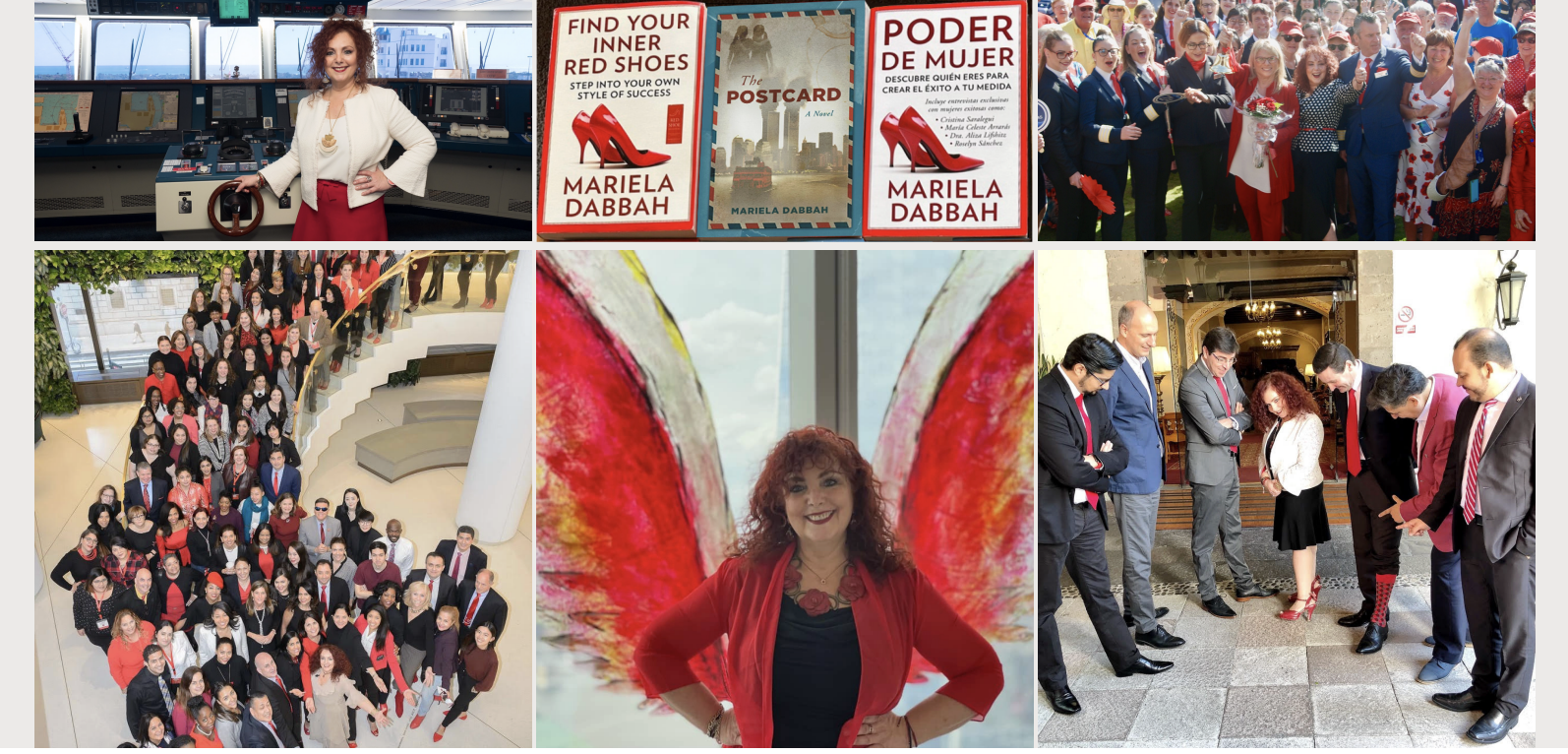
Mariela Dabbah is an Argentinian-American author and entrepreneur whose work focuses on helping immigrant, underrepresented talent and women navigate professional life in the United States. She is the founder of the Red Shoe Movement, a leadership development company powered by a global community of professionals who support each other for career success.
Dabbah’s story is deeply connected to migration. Her maternal Jewish family escaped Nazi Germany and rebuilt their lives in Argentina, while her paternal side had emigrated from Lebanon and Syria in the early 1900s. Years later, she became the first in her family to move back north, immigrating to the United States as a young, recent college graduate and starting over without professional connections or a support network.
Before founding the Red Shoe Movement, Dabbah worked in publishing, education, and media, writing books to help Latino families connect the dots to success and appearing regularly on Spanish-language television. Over time, her work evolved into a broader conversation about career ambition, and how women define success for themselves — not through expectations imposed by society, but through the lives they want to build. As her company continues to expand and evolve, it has become an influential beacon in the corporate world helping organizations foster inclusive cultures.
What was your journey to get to where you are right now?
I got married and emigrated to the United States shortly after graduating from the University of Buenos Aires, where I studied philosophy and literature. I found a job in book distribution, working with school systems across the country on English as a Second Language and bilingual education programs.
Later, I got divorced, and that period pushed me to focus more seriously on my writing career. I had been writing since I was nine years old — poetry, novels, short stories — so writing had always been part of who I was. But I launched my professional career through nonfiction. My first book was Cómo Conseguir Trabajo en los Estados Unidos: Guía Especial Para Latinos, a guide for Latinos looking for jobs in the U.S.
After my second book came out, I became a spokesperson for McDonald's scholarship programs for Latino students. I started appearing regularly on television and in the media, helping people understand how to build careers and access educational opportunities in the United States. We also created workshops around the country to help students navigate the scholarship process.
At the same time, I was leading workshops for parents because many of my books were geared toward families. I helped parents understand how to support their children through school so they could fully benefit from the opportunities available to them in the United States. I would sign thousands of books, and for many people, it was the first book they had ever owned.
After that, I co-authored The Latino Advantage in the Workplace: Using Who You Are to Get Where You Want to Be, which brought me into the corporate world. We began working with companies to help Latino professionals recognize their strengths and advance in their careers. After several years, I noticed that women were not advancing as quickly as they should. That led me to write Find Your Inner Red Shoes — and that book became the foundation for the Red Shoe Movement.
Who was the most influential woman in your life?
My grandmother, Lore Levi. I always get emotional when I talk about her.
She grew up in a very wealthy Jewish family in Germany and studied to become a kindergarten teacher. When the Nazis came to power, she first moved to Italy where she met my grandfather and then they escaped to Argentina with my mother, who was only eighteen months old.
My grandfather, who had been a successful lawyer in Germany, told her, “You’re going to need to find a career here. You need to be independent.” She went on to become one of the first female psychologists in Argentina.
I spent a lot of time at her house, especially when I started college. We had incredible conversations. She was the person you could talk to about absolutely anything. When I was fifteen, she told me that if I ever felt ready to become sexually active, I should come to her first, and she would take me to a gynecologist so I could make informed decisions and protect myself. At the time, that was extraordinarily progressive.
When I was sixteen and dating an older boyfriend, she would let us stay at her apartment because she felt safer knowing where I was than having me out alone in the city. She had lived through periods when people simply disappeared. During Argentina's military dictatorship, thousands of people were detained, tortured, and never returned. That experience stayed with her, and I think it shaped the way she worried about the people she loved.
Years later, when I was considering divorce, I went to see her while she was very ill. She looked at me and said, “If you're coming here to ask for permission to get divorced, you have it. But you don't really need anybody's permission.”
What was everyday life like for ordinary people living under Argentina’s military dictatorship during the Videla era?
It was frightening.
Many people tried not to believe what was happening until it was impossible to ignore. Thirty thousand people disappeared. Many of them were Jews. Many of them came from the same university that I later joined.
I started university in 1983, the first year of democracy. The walls were still covered with graffiti left from the dictatorship years. For the entire five years I was there, I never made a close friend. I didn’t give anyone my phone number. I was terrified. During the dictatorship, people were taken, tortured, and forced to reveal information about others. That fear lingered long after the regime ended. It took years for people to regain a sense of trust.
One of the ideas that runs through your work is that success means something different for everyone. When did you first start questioning traditional definitions of success?
The whole book is really about that.
Success has traditionally been defined by society, and often through expectations that were not created with women in mind. At some point I began asking myself: why should success mean the same thing to me that it means to someone else?
I want people to define success for themselves.
Some women have come to me and said, “I want to have a family. I don’t care about having a career.” Wonderful. If that is what fulfills them, then that is success.
For someone else, success might mean becoming a CEO. For another person, it might mean financial independence. For someone else, it might mean creating a life with a little bit of everything.
Success is not one-size-fits-all. Learning how to define it for yourself is one of the most important things you can do.
How did the Red Shoe Movement get its name?
This is actually a funny story.
When my book Find Your Inner Red Shoes was being prepared for publication, I was presented with several cover options, and none of them felt right. So I went online and found an image of red stilettos myself. To me, they represented power with femininity.
When the book came out, journalists kept asking me, “Why are there red shoes on the cover?”
Then one day I was doing a live television interview on Al Rojo Vivo, and the host asked the same question.
Without thinking, I said, “Because I’m going to create the Red Shoe Movement.”
She looked at me and asked, “What is the movement?”
I replied, “A movement of women who support each other.”
“And what do they support each other for?”
“For career success.”
When we got off the air, she laughed and said, “You should have told me. I would have worn red shoes.”
And I said, “I literally just made that up.”
But after saying it out loud, I realized I wanted to make it real.
I started building a community of women ambassadors, and everything evolved organically from there.
What do you wish someone had told you when you first arrived in the United States?
That building a network is just as important as working hard.
When I arrived, I knew almost nobody. Every opportunity I had came from reaching out to people, introducing myself, and building relationships from scratch.
I cold-called publishers. I pitched myself to media outlets. I knocked on doors. Later, when I entered the corporate world, I had to do exactly the same thing all over again.
Nobody hands you a roadmap. You have to create one yourself.
What would you say to immigrant women who are still finding their voice today?
Build relationships with people who do not look like you and do not sound like you.
One of the biggest mistakes immigrants make is staying only within their own community. It feels comfortable, but it limits your understanding of how things work.
The more diverse your network becomes, the more opportunities you will discover. Surround yourself with people who have been where you want to go. Learn from them. Ask questions. Pay attention.
The faster you understand how the system works, the faster you can find your place within it.
And remember: people open doors for people. Building those relationships matters.