Monique Clesca: Inherited Voices
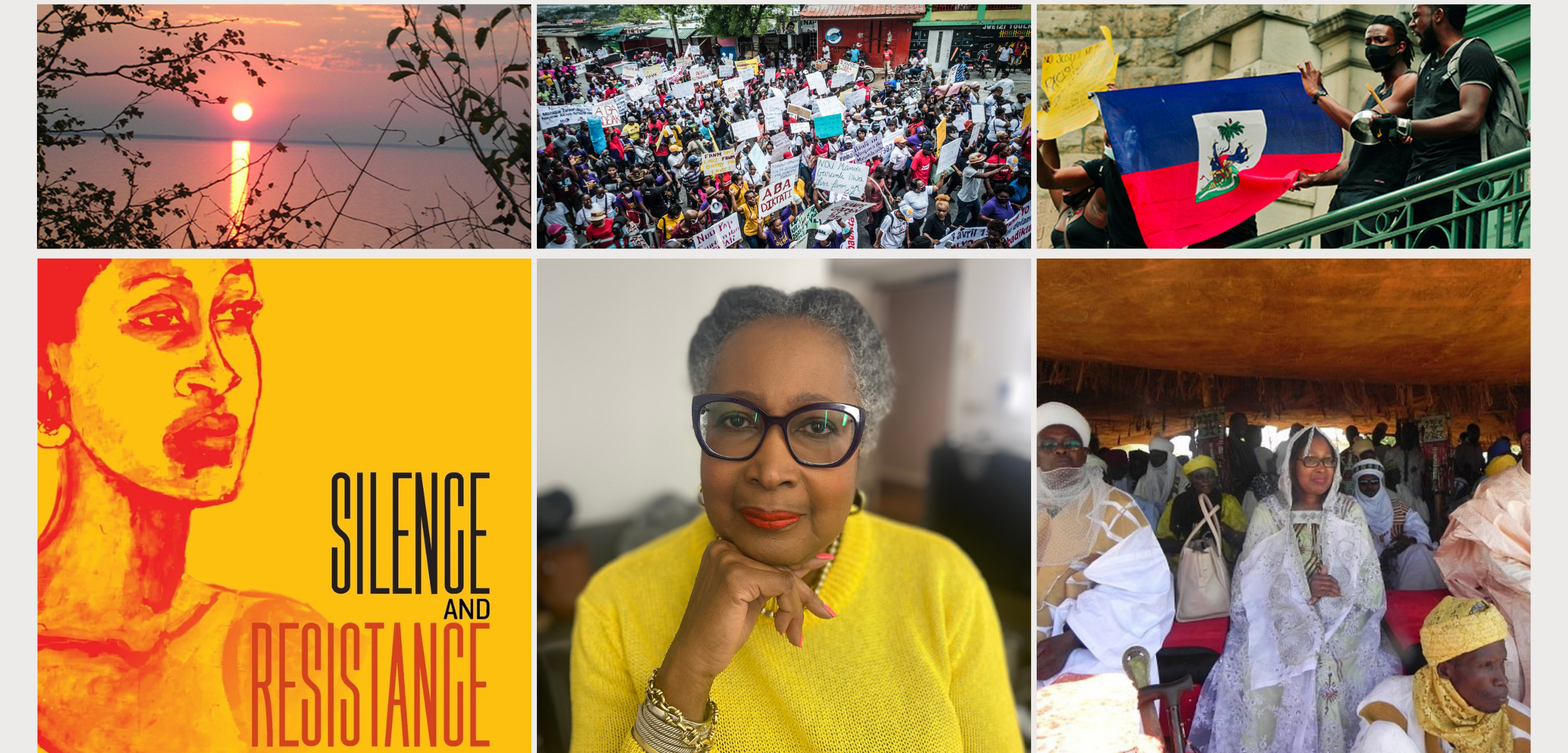
Monique Clesca is a long-time advocate for women’s and children’s rights whose work spans Haiti, the United States, and Africa. Her career has been shaped by a refusal to treat silence as neutral.
She has lived two intertwined professional lives. One unfolded in international development, where she spent decades advocating for women and children and contributing to policy discussions related to Haiti and Africa. After retiring from full-time work at the United Nations in 2016, she continued working as an international consultant. Alongside this, she emerged as a prominent feminist and pro-democracy voice in Haiti, speaking publicly against corruption, political violence, and gender-based injustice. Her work has remained grounded in community engagement: for years, she has volunteered with a women-led organization supporting survivors of domestic and sexual violence. In recognition of her leadership in a nationwide movement to end child marriage, she received Niger’s highest national honor.
Her second life is writing. Clesca is the author of two self-published books in French: La Confession, a novel about a woman asserting herself through love, grief, and loss in a patriarchal society, and Mosaiques, a collection of essays focused on women facing human rights violations. In recent years, she has turned to memoir, completing Silence and Resistance: Memoir of a Girlhood in Haiti, which brings together memory and history while asking how private experience becomes political. Her writing is marked by clarity and restraint, and by a sustained insistence on naming what silence conceals.
On January 12, 2010, a devastating earthquake struck Haiti, killing and injuring hundreds of thousands. In an instant, the physical landmarks of Monique Clesca’s life collapsed, triggering a deeper rupture within. Clesca's memoir, Silence and Resistance, traces the aftermath of that moment as a journey into childhood and family history. She recounts her upbringing under state violence and enforced silence, as well as the generational secrets that haunted her family.
Set against Haiti’s singular history, the book explores love, trauma, and belonging through the legacy of her father—a man she loved, who was also responsible for an unforgivable act. Confronted with this revelation, Clesca is forced to reckon with betrayal and the moral complexity of loving someone capable of profound harm. Through precise, unsentimental prose, Silence and Resistance becomes a meditation on the courage required to reclaim one’s voice.
The questions that run through Silence and Resistance—inheritance, memory, and what is carried forward—do not stay on the page. They shape how Monique Clesca’s story can be given form.
Monique’s skirt draws from the same sources as her writing, moving between family lineage and colonial history. It takes its shape from the traditional Caribbean karabela dress, reimagined as two half-skirts placed in conversation. One side opens into a floral print, dense with tropical blossoms. In Clesca’s writing, Haiti’s landscape is described with such sensory care that flowers and ripe fruit feel almost within reach. This half of the skirt gestures toward that world of memory and immediacy, and toward her grandmother, Grand Angele, whose spiritual presence anchors the family’s past.
The other half is made of madras cotton, patterned in vivid orange and blue. Madras arrived in the Caribbean through colonial trade, a lightweight cotton produced in India and circulated through plantation economies controlled by European powers. Over time, enslaved and free Black communities claimed the fabric as their own. What entered the Caribbean through colonial trade was reshaped into a material of self-definition, marked by its origins but no longer defined by them.
Clesca’s story unfolds between the spiritual universe of Haiti, marked by Vodou and political rupture, and the Western world which she explored more fully after moving to the United States at twelve. The skirt reflects that crossing. The floral half honors Grand Angele. The madras half gestures toward another ancestor, Jean Joseph Clesca, whose legacy Monique explores in her documentary À mon aïeul français (To My French Ancestor). In the film, Clesca follows the trace of her white French ancestor from France to Haiti, arriving in Nantes to confront the legacy carried by a family name. The skirt’s interchangeable form allows for the decision of what is revealed and what is kept close, mirroring the way identity is shaped through memory and choice.
The memoir Silence and Resistance returns repeatedly to her grandmother, Grand Angele, whose presence anchors the family’s spiritual inheritance. One of its most vivid passages recalls the moment Clesca first witnessed that presence as a child.
“I didn’t comprehend everything, but I noticed the respect shown to Grand Angele. Overwhelmed by my curiosity, I whispered in Papa’s ear to ask him what was happening. ‘Moka, Grand Angele is the Mambo. She is like the priest when you go to Church,’ Papa explained quietly. ‘This is how they pray. They are possessed by spirits who give them strength.’ I felt special, powerful even sitting on Papa’s lap in the front row looking at Grand Angele as the priestess officiating at this Voodoo ceremony.”
“Then they all sang to Papa Legba: ‘Papa Legba, Louvri baryè pou Atibon, Louvri baryè pou mwen, Papa pou mwen pase.’ They asked him, as the guardian of the gates of the mystical world, to open them to clear the paths so the spirits could pass through and join us mortals. For Papa Legba was a wise old man who had travelled from Africa to Haiti, Cuba and Brazil with his people. He helped them survive slavery, start new lives, and bless their journeys.”
“I knew that the quiet order of my first eight years was now very much in the past because I had seen with my own eyes how Grand Angele had metamorphosed into someone else. I was astounded and mystified; I had been hypnotized.
From then on, I could not stop looking at Grand Angele. She was also possessed by other spirits, for when the drums spoke in the Yoruba, Igbo, or Kongo sounds of her ancestors, they resonated with her. When the spirit Erzulie, the goddess of love who came from Guinea in West Africa, danced in her head, Grand Angele the seductress twirled like a young woman flirting, the skirt of the bright-yellow dress she loved to wear billowing around her. Legend has it that Erzulie shared a passion with Ogou, who also loved Clermezine, the sad lady who always lost in love.
She was most often possessed by Général Vaval, a name given by the family to the Yoruba god Ogou, god of war, thunder and fire. An ancestor who knew the ways to her mind and body well, he came and went at will in her head. When Général Vaval took control of her consciousness, she became him. She was fierce with his power, put a machete in the belt of her red dress and scared all who needed to be scared. She also decoded dreams. Papa Loko, the wise old farmer who had blessed Viola and me, was also a master of her head, as spirits are sometimes called.
Years later, I talked to Tante Yvonne when I became acutely aware that I also needed for Papa Legba to open the gates for me to better comprehend Grand Angele, the family history, and the symbolism of this religion that is so fully connected to the natural elements. She quoted one of Grand Angele’s favorite lines about her spirits: ‘They are my mystères, the masters of my intelligence. I must celebrate them regularly.”
This understanding deepens in a later passage, when Clesca describes her own participation in Voodoo ceremonies:
“I also went to Voodoo ceremonies. I had missed these ancestral rituals, which deeply connected me to my paternal family. The larger story started to emerge: Grand Angele was more than my grandmother; she was a poto-mitan, the central anchor of our family. She belonged to all of us because she carried a special legacy and was guardian of our heritage. I felt a certain invincibility, even a degree of legitimacy from being part of that legacy. I finally understood my family at the most profound level. Through the spirits that possessed her and the rituals she carried out, Grand Angele transmitted the positive, tolerant, and benevolent aspects of the Voodoo religion. She formed part of an unbroken chain of transmission starting in Africa and passed from father or mother to son or daughter.
Even her name, Angele, identified her role. It came from the Greek eggelos, which meant messenger. She had brought the past from Africa to us.”