Neta Elkayam: Carry the Song Forward
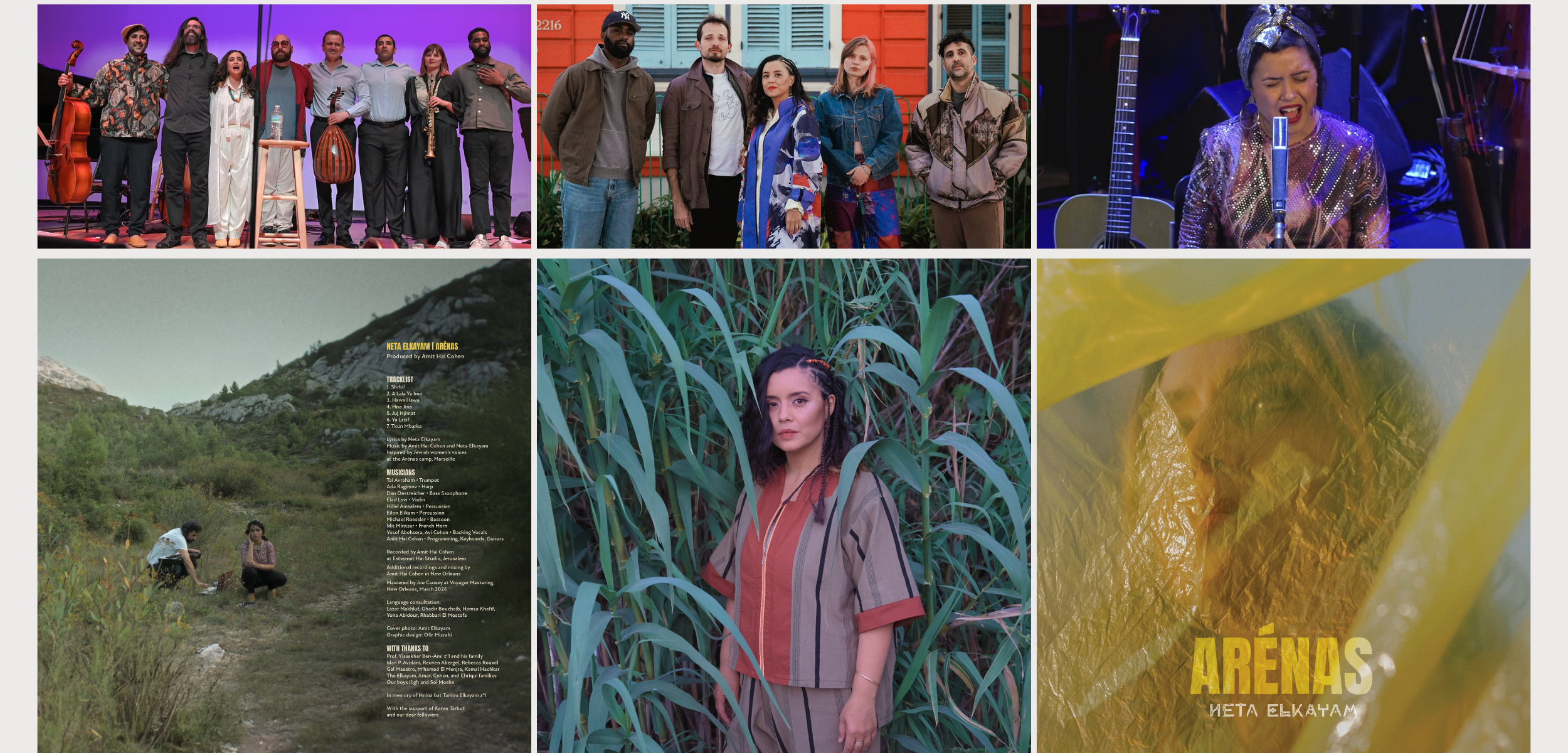
Neta Elkayam is a Moroccan Jewish Vocalist, multidisciplinary artist, and cultural activist whose work explores the rich musical traditions of Morocco’s Jewish communities. Born and raised in southern Israel to a family of Moroccan Jewish immigrants, she grew up between two distinct cultural worlds: her father's Amazigh roots from the Atlas Mountains and her mother's Sephardic, French-influenced heritage from Casablanca. These family traditions, along with the songs, languages, and stories passed down through generations, became the foundation of her artistic practice.
As the granddaughter of Jews who left Morocco during the mass migration to Israel in the mid-twentieth century, Elkayam belongs to a generation rediscovering cultural traditions that were often pushed aside in the pursuit of assimilation. Through music, language, and performance, she has dedicated herself to preserving and reimagining this heritage for contemporary audiences. Singing primarily in Moroccan Arabic, she explores questions of memory, migration, identity, and belonging while building connections between cultures that are often seen as separate.
In addition to her solo work, Elkayam collaborates with artists across musical traditions and has created acclaimed projects inspired by Moroccan Jewish history, archival recordings, and the experiences of migration. Her most recent album, Arènas, draws inspiration from recordings made in the transit camps of Marseille, where many North African Jewish immigrants passed through on their journey to Israel in the 1950s and 1960s. Using fragments of these voices and songs as a starting point, Elkayam transforms historical recordings into contemporary compositions, weaving the experiences of those early immigrants into music that feels strikingly relevant today.
Tell me about your background and what shaped you as an artist?
My paternal grandmother was deeply spiritual. She couldn’t read or write, so she expressed her faith through singing and improvisational prayer. That had a huge impact on me. My father also became an artist after losing his brother in war as a teenager. Painting became his way of processing grief and preserving his brother’s legacy. His work was deeply inspired by Moroccan and Islamic visual traditions, blending Jewish symbolism, mysticism, and non-figurative forms.
I grew up in a home where art was both healing and survival. I saw creativity as a way to process pain and make sense of difficult experiences. Whenever something hard happened in my life, my instinct was always to create—I wrote poetry, drew, painted, and eventually found my way to music. Music was always present, but it became especially meaningful when I connected with my first music teacher, Marina, who immigrated from Russia in the 1990s. She opened up a whole new world for me and helped me understand how powerful music can be as a form of expression and connection.
I’ve always been drawn to things that felt distant from my immediate reality—different cultures, languages, and even different time periods. It wasn’t really nostalgia; it was more about imagination. I was fascinated by places I’d never seen, eras before I was born, and the idea of the future. Languages became a big part of that curiosity, and I’ve always loved singing in different languages.
Moroccan Arabic plays a central role in your music. What was your relationship with the language growing up?
Hebrew was my first language, but Moroccan Arabic was always around me at home. My parents and relatives spoke it with friends and family, and I picked it up by listening. At times, they were surprised I understood everything they were saying.
But growing up in Israel, many families from Arabic-speaking Jewish communities felt pressure to leave those languages behind. Arabic was often viewed as the “enemy’s language,” so many parents avoided speaking it publicly and tried to assimilate.
That had a real cultural cost. Many artists, including Zohra Al Fassia, experienced this shift firsthand. She was once celebrated in Morocco for bringing Jewish and Muslim audiences together through Arabic music, but after moving to Israel, that music was no longer valued in the same way. Tastes changed, assimilation pressures were strong, and many immigrant artists were pushed to the margins.
What does singing in Arabic mean to you as a Jewish artist?
Moroccan Arabic is my Jewish language. I have Hebrew, which is my daily spoken language and the language of my prayers, but Moroccan Arabic connects me to a much older Jewish history—to a time, when Jews lived across the diaspora and spoke the languages of the places they called home. They prayed in Hebrew, but that wasn’t always the language of everyday life.
When I bring that to the stage, I think people begin to understand that these identities are not contradictory—they’ve always existed together.
Has your understanding of identity changed as your music has reached audiences beyond Israel?
I think my relationship to identity has definitely changed. I don’t place as much weight on it as I used to, and in some ways that feels freeing. Being outside of Israel and living in New Orleans for the last couple of years has given me perspective. I still deeply value those identities, but they’re no longer the goal.
For me, the goal is connection—using my personal story to speak to something more universal. It’s not about saying, “I’m proud to be Moroccan” as an end in itself. What interests me is taking all the colors of my identity—culture, language, history, the people I meet—and creating something new with them. Every generation adds its own layer.
I feel grateful that my music now reaches people far beyond my immediate community. I collaborate with jazz musicians here in New Orleans, perform for international audiences, and connect with people who may not share my background at all—they simply connect to the music.
Can you tell me about your creative process and how your recent album came together?
This album emerged from a moment when I felt creatively stuck. I was becoming bored with simply being seen as “a Moroccan singer.” I had learned many traditional songs, but I wanted to create culture—not just preserve or decorate it.
Then I was invited to explore the audiovisual archives at the National Library in Jerusalem. While searching through recordings, I found four tapes recorded in transit camps in Marseille during the 1950s and 1960s.
The recordings were extraordinary. You could hear women from the Atlas Mountains humming old songs, babies crying in the background, the sounds of migration happening in real time. It felt like discovering a message in a bottle.
A researcher had recorded these voices in an effort to preserve something he knew might disappear. When I later spoke with his family, they told me they never imagined anyone would value his archive in this way. We invited them to the premiere of the project, and they were incredibly moved.
For the album, I was inspired by fragments of those recordings—sometimes just a single phrase or melody—and used them as a starting point. From there, I expanded them into entirely new songs.
You mentioned hearing African influences in these archival recordings. What did you discover in that music?
It felt very connected to the mountains, to Africa. I spoke about it with an Ethiopian friend, and she said it reminded her of Ethiopian music too—the pentatonic scales, the improvisation.
I realized I had found my ancestors’ blues. It felt deeply feminine and connected to everyday life. These songs helped women process loss, celebrate joy, and bless their families. Our grandmothers were always blessing people—that was part of daily life.
I wanted to continue that tradition in a contemporary way. If there’s grief, let’s process it through their wisdom. If there’s joy, let’s celebrate it through their language. I took those emotional and musical elements and connected them to songs I was writing today.
Together with my partner and collaborator Amit, we brought in electronic beats because the repetition in this music felt almost trance-like. We wanted it to feel both ancient and futuristic—something you could dance to and cry to at the same time.
At a time when conversations about identity and coexistence feel increasingly difficult, what role can music play?
I think this work feels more relevant than ever. Someone once told me that music is the opposite of war, and that really stayed with me. In war, people hold instruments of destruction. In music, we hold instruments of connection.
That’s what I choose to hold onto. I don’t have another way to resist—music is my resistance.