Tursunay Ziyawudun: A survivor of Chinese reeducation camps
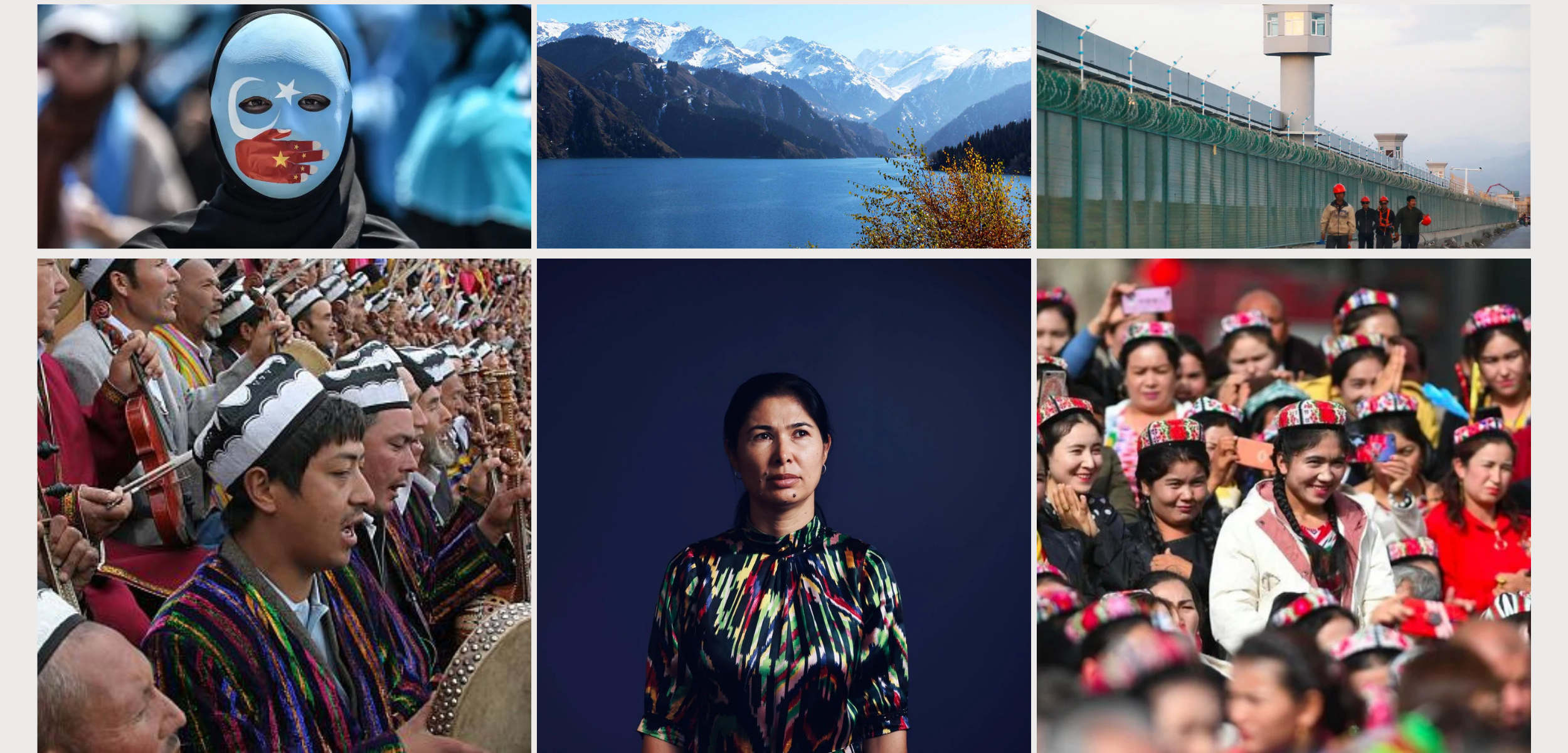
Tursunay Ziyawudun is a survivor of the Chinese government’s detention camps in the Uyghur Region and a vocal advocate for Uyghur human rights. She was born in Künes County, Xinjiang, and moved to Kazakhstan in 2010.
In November 2016, she returned to China to renew her passport - only to be detained upon arrival under the government’s “strike first” policy, a preemptive security doctrine that authorizes authorities to arrest individuals deemed potential threats before any crime has been committed. Over more than a year in two detention camps, she lived under conditions of constant deprivation and control, where forced medical interventions and relentless political indoctrination were used to strip away her culture and identity. After her release in December 2018, she returned to Kazakhstan.
In 2020, as threats to her safety mounted, Tursunay fled and ultimately entered the United States on special parole. Since then, she has transformed survival into testimony, speaking with human rights organizations, researchers, and journalists to document China’s treatment of Uyghurs and other Turkic Muslim communities.
I met Tursunay through Sureyya Kashgari, the founder and director of Ana Care and Education, a Uyghur language school. I had initially come to interview Sureyya about her experiences living in Xinjiang under the CCP in the 1990s, but she urged me to also meet Tursunay - someone who could speak to what life in the region looks like today.
In the mid-2010s, China began constructing what it called Vocational Education and Training Centers across the Xinjiang Uyghur Autonomous Region - facilities widely known as “re-education camps”. Following incidents of unrest, the government launched a campaign labeled “Strike Hard Against Violent Terrorism,” dramatically expanding surveillance and security measures and laying the groundwork for the mass detention of Uyghurs and other Turkic Muslim communities.
Under this campaign, thousands were taken without charge or trial and disappeared into sealed camps. Chinese authorities maintain that the camps are benevolent - designed to curb extremism and preserve social stability through political instruction, Mandarin education, and vocational training.
Survivors like Tursunay, supported by extensive human rights reporting, describe something far darker: people detained for everyday expressions of faith or culture, subjected to coercive indoctrination and relentless surveillance, their religious lives tightly controlled, their labor exploited, and their bodies disciplined through abuse. What the state presents as education, is for many a system of fear and silence.
Tursunay’s words lingered long after our interview, you can read her full testimony here, though please be aware it contains graphic descriptions of torture and sexual violence.
Today, Tursunay works as a tailor in Maryland, her studio based at Ana Care School. The room is filled with beautiful dresses and costumes, many made for the traditional Uyghur festivals. She’s constantly busy with clients trying on wedding dresses or picking up orders made from vibrant atlas silk fabrics, and when there’s a moment alone, she’s on the phone with relatives or friends, laughing.
I was fortunate that Tursunay not only agreed to be one of the heroines of my project but also took part in creating the skirts for this collection. Still learning English, she and I communicated mostly through Sureyya. The three of us spent hours together, talking over designs and selecting fabrics, pouring creativity into the stories. Two months later, I returned to place another order and was greeted with news that Tursunay had recently gotten married. They showed me the wedding album; faces alight with joy, love uncontained. Tursunay, breathtaking in a white lace dress, stood at the center. She remains, without question, the strongest woman I have ever met: fearless in speaking out against the CCP and Xi Jinping, and resolute in her fight for the Uyghurs still imprisoned in China.
The skirt we designed together is a maxi skirt with large white flowers, symbolizing Uyghur women. Inside the flowers are embroidered their names: Amina, Gulnisa, Shirin, Aynur, Mahinur, Perizat, Peride, Mihriban, Gulzar, Nilufer, Gulbahar, Zulpiye, Adalet, Guli…
“My physical body is free, and so is my voice… I am only beginning to overcome this suffering by telling my story.”
“Millions of Uyghurs are suffering, and they are alive only because they have the hope and belief that there is justice in this world.”
“As a survivor, I will not stop—not even for one minute—being a voice for all the people who have not survived, and for the people in East Turkistan who are trapped in a hellscape, placing their hope in the outside world.”
“I thank the U.S. government for rescuing me and giving me safe haven in this country. Without the quick action of U.S. diplomats abroad and officials at the State Department, I do not know where I would be. At best, I would still be a stateless refugee, fearing that the Chinese government could force me back at any time. I would not have had the courage to tell anyone what really happened to me.”