Ana Harvey: The Courage to Say Yes
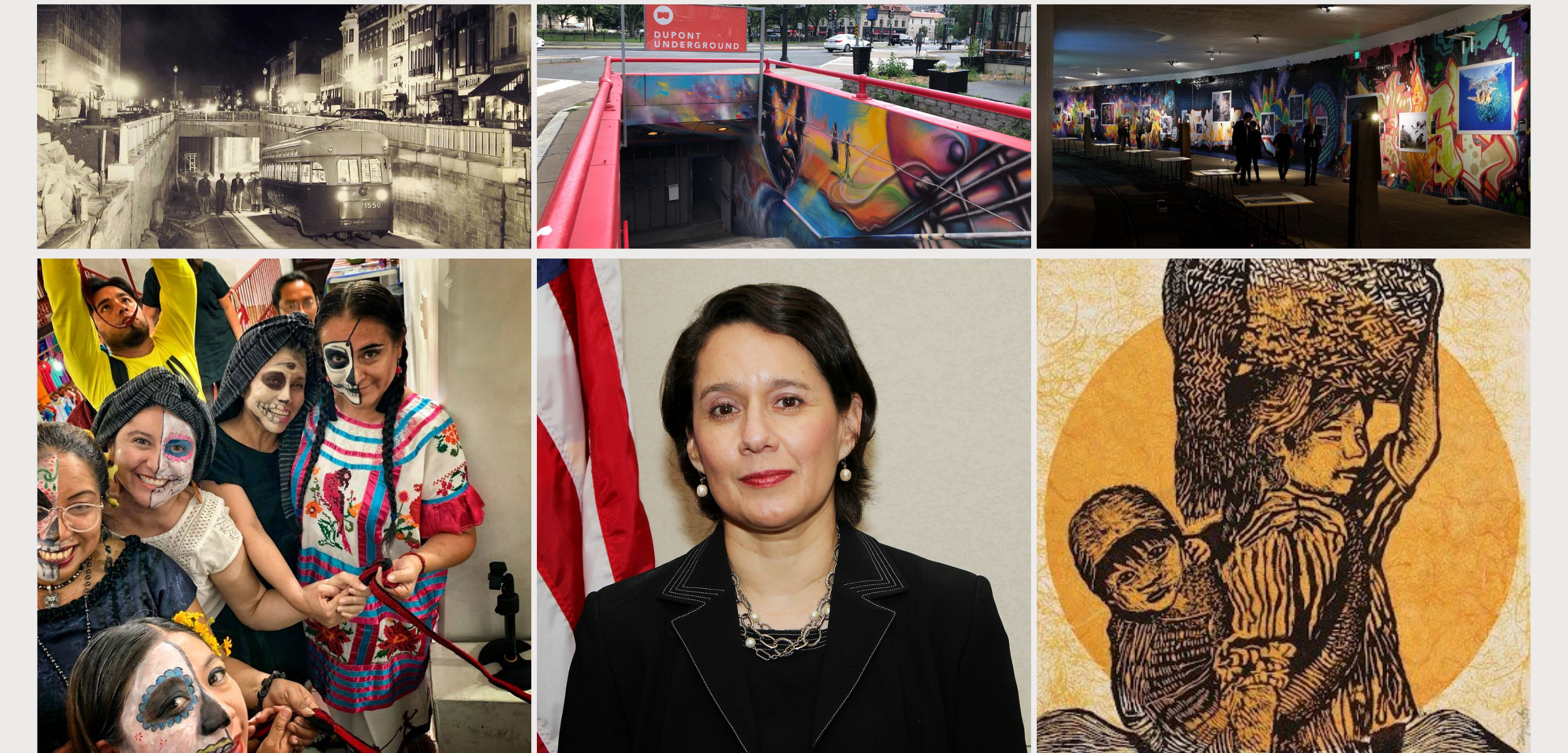
Ana Harvey arrived in the U.S. from Mexico City at twenty-one with little more than her own resolve. After quickly mastering the language, she then turned that skill into a foundation, meticulously building a translation company from an idea into an enterprise. From there, her career became a masterclass in audacious reinvention: she championed Latino business as head of the Greater Washington Hispanic Chamber of Commerce, shaped national policy for women entrepreneurs in the Obama White House, and guided the small business heartbeat of the nation’s capital. In 2017, her work opening pathways for Mexican communities abroad was recognized with the Ohtli Award, one of the highest honors bestowed by the Government of Mexico on people living outside the country. At every turn, Harvey has operated with a singular vision: seeing brilliant potential in the places and people others simply pass by.
That same instinct now shapes Harvey’s work as CEO of Dupont Underground, where she has taken on the unlikely task of animating an abandoned streetcar tunnel beneath one of Washington’s busiest circles. What began as a neglected, nonfunctional space has become a living cultural site—hosting performances, exhibitions, and community gatherings that thrive precisely because of their unconventional setting. Harvey approaches the Underground through an unshakable belief that value can be created where others see only obstacles. It is from within this evolving project that Harvey spoke about leadership, risk, and the practical work of sustaining cultural spaces in Washington, D.C.
What are the origins of the Dupont Underground?
It started about ten years ago, founded by architects Hunt and Laudi, who rediscovered this abandoned tunnel. They saw its potential not just as a physical space, but as a place for civic discourse. When I joined after the pandemic, the lease with the city was expiring. I helped negotiate a new one, then joined the board, proposed myself as CEO, and they agreed.
You had experience running agencies and businesses, but not art exhibitions. What made you say yes?
I’ve run my own company, federal agencies, and local agencies. I’m good at running organizations—fundraising, strategy, and building trust. I’ve always loved art; I have a degree in art history, but I’m not an artist. When I came to Dupont Underground, the purpose was its survival. But once here, I quickly learned that you have to do everything, including curating. And it has worked.
What was the first event you chose to curate?
It was a Día de los Muertos celebration, a tradition deeply rooted in my country, Mexico. It was very close to my heart. My first memory of Día de los Muertos is at my grandmother’s house. She had lost two children very young. I remember her preparing the altar with their photographs, candles, and their favorite foods. She told me they were going to come that night to visit us, because they never really leave. For a little girl, that idea was both beautiful and slightly terrifying.
How did that memory translate into an exhibition?
I traveled to Oaxaca, which is the heart of Día de los Muertos—most of the iconic images people associate with the holiday come from there. I was led to a cooperative of women artists. These were formally trained painters who had studied alongside the now-famous male painters of the state. They had the same education and the same talent, but not the same support. They weren’t paid equally, exhibited equally, or hailed as masters. Their response wasn’t to quit; it was to form a collective and say, We are here. We are equally talented.
When I asked one artist if I could bring her work to Washington, she shook her head and said no—you bring all of us. So I did. I brought one piece from each of the twenty-nine women, literally carrying their art in my suitcase. The exhibition was powerful because it celebrated more than the tradition; it celebrated their resilience and their womanhood. It was the perfect first project for me here—it was about seeing and elevating overlooked brilliance.
Later, I curated a second show with them on the rebozo, the traditional Mexican shawl. To my grandmother, it was a practical tool—for carrying babies or groceries. But today, it’s a profound symbol of everything women do: the strength, the care, the labor, the pride. Bringing that narrative here, to this raw, underground space, felt like completing a circle. It was about honoring the past while insisting on a new kind of recognition.
Why did you come to America?
I came to the U.S. in 1985 to study. My father said something painful but honest: “as long as you don't end up working at McDonald’s your whole life.” That was what many people assumed Mexican immigrants would do. I never felt unwelcome, but I knew I had to create my own path. I started a translation company from scratch, which led me to the Greater Washington Hispanic Chamber of Commerce. Its president suggested that I should succeed him. I never imagined that for myself, but he asked, why does someone else have to see your potential before you do? That changed everything.
What surprised you when you arrived?
I was very excited to be here, and one thing surprised me immediately: I never felt unwelcome. I went to school, made friends, did well. I thought I spoke English—until I arrived in Texas.
I studied psychology and wanted to finish my degree at the University of Houston, but my English wasn’t good enough yet, so I spent a semester learning English first. I’ve always loved art, so when I had the opportunity to minor in art history, I took it. I interned at the Museum of Fine Arts in Houston and at a university gallery, and that’s how I first worked in the art world.
Then I had children, and everything paused for a while. I moved to England briefly—I married an Englishman, and we lived in Ipswich, not too far from Cambridge. It was very hard for me. Honestly, it was boring.
I have two children: Andrew, born in Houston, and Alexandra, born in Ipswich. Eventually, I couldn’t take the small-town feeling anymore, and we returned to the U.S.
We had three options: Texas, Orange County in Los Angeles, or Washington, D.C. When I drove through the National Mall for the first time, I fell in love, and we chose D.C., though we initially lived in Virginia.
When did you start working full-time?
I never worked outside the home when my children were young, but I needed to work. I wanted to work. So instead of finding a job, I started my own company—a translation agency. I began as a freelance Spanish translator and built the company on that foundation. One day, a client asked if we worked with French. I didn’t have a French translator at the time, but I said yes. I found one, expanded the team, and within two years the company grew to seventy-five translators working in twenty-five languages.
That “yes” changed everything. It led me to the Hispanic Chamber of Commerce to find clients, which became one of the most meaningful decisions of my life. That job led me to the Obama White Administration, to running D.C.’s small business programs, and to consulting for nonprofits. It’s the same belief I bring here: the potential is already there. You just have to recognize it and build the structure around it.
That journey took you to the Obama White House and then to running D.C.’s small business programs. How does that experience inform leading a cultural space?
It gave me the skills to turn vision into reality. Whether it’s a woman entrepreneur, a struggling nonprofit, or an abandoned tunnel, the principle is the same. You have to first assess, then plan and execute. Again, it worked! Now, we’re creating a theater for unconventional productions. I knew nothing about theater. I jumped in and learned as I went.
What does Dupont Underground represent now, to you?
It’s proof that value can be created where others see only obstacles. Just like those women artists in Oaxaca, this space was here, full of potential, waiting for someone to look at it not for what it was, but for what it could become. That’s the work. And it’s never finished.