Sureyya Kashgary: Building a School Where the Uyghur Language Can Still Be Spoken
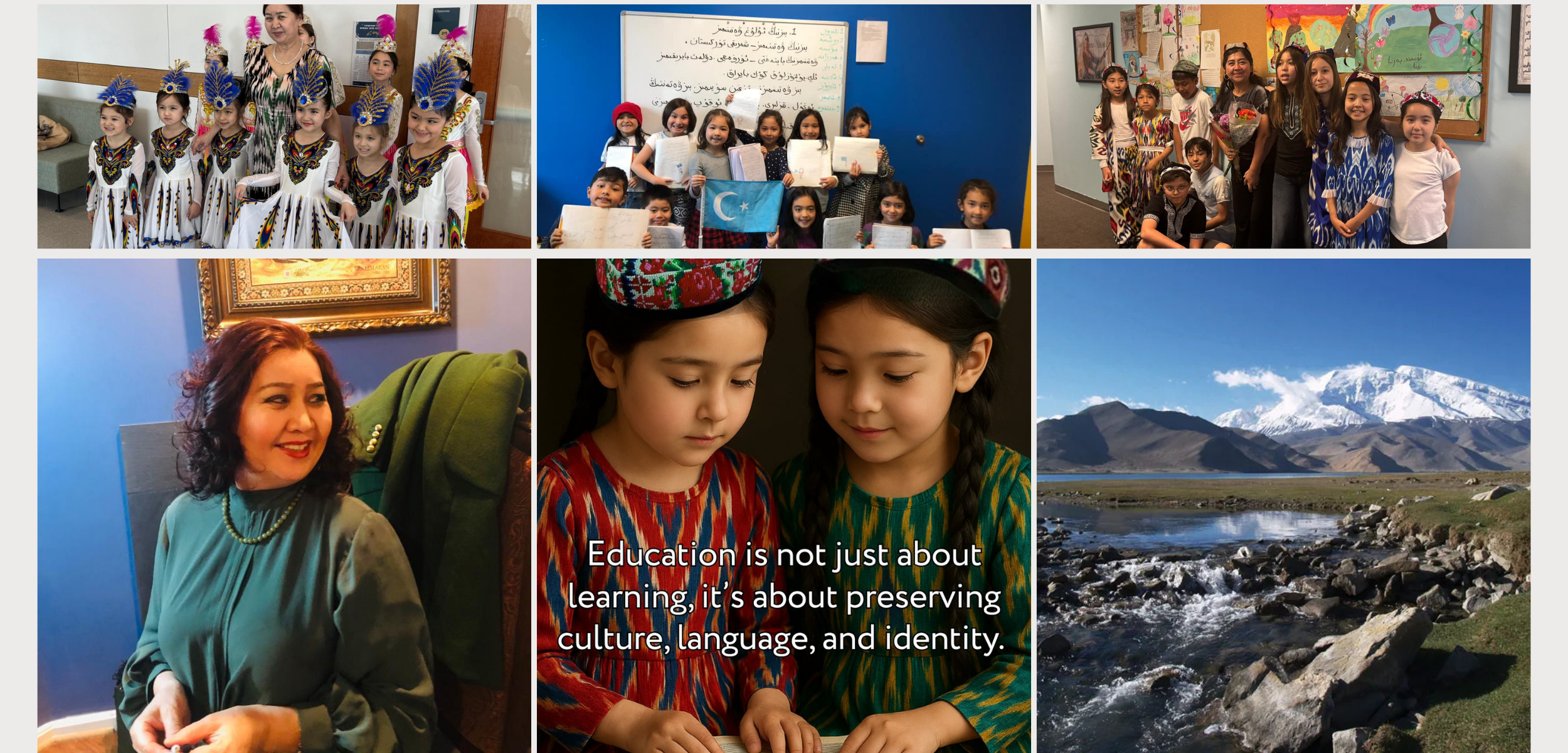
Every Sunday in the DMV area, the doors of Ana Care and Education open. Its founder, Sureyya Kashgary, has created a space where Uyghur language and culture are still allowed to flourish. She has become the driving force behind preserving a heritage under threat, guiding children to speak, remember, and carry it forward.
Sureyya moved to the DMV area in 1999 with her husband and daughter. In 2017, she founded Ana Care. Today, more than 100 children gather every Sunday to learn their mother tongue, to dance, make music, create art, and absorb the values of a heritage that has endured for centuries — and is now fighting to survive.
The urgency of her work becomes clear when considering who the Uyghurs are. A Turkic Muslim people indigenous to East Turkistan — officially the Xinjiang Uyghur Autonomous Region of China — their culture has been shaped over centuries by Islam, trade along the Silk Road, communal gatherings, and a deep reverence for poetry and learning.
Today, that way of life is under systematic attack: under the rule of the Chinese communist party, the language is disappearing from schools, places of worship and remembrance have been demolished, and millions have been subjected to surveillance, detention, and forced confinement. Even ordinary gatherings are treated as dangerous, as unity itself is seen as a threat.
Ana Care is a space where children come to learn the language, songs, and dances, but its also a space that encourages to inhabit a culture that continues to exist against impossible odds. Sureyya’s work takes form through her dedication to cultural continuity and through a community space that can hold together an entire heritage.
Rising Tensions in Ghulja
In the mid-1990s, in Ghulja, China — Sureyya’s hometown — the community faced a growing crisis. Many young Uyghur men were dying unexpectedly, often from heroin, which was spreading rapidly. While the Chinese government maintained tight control over most of China, in East Turkistan, harmful substances and outside influences flowed with little restriction. Families were terrified: their sons were dying, and they had no power to stop it.
Community leaders stepped in to protect the youth. They encouraged young people to stay connected to their traditions and religion, to maintain discipline, and to avoid drinking and smoking. The meshrep — the traditional Uyghur community gathering — regained its central role. More than a celebration, it became a space that brought families together and gave young people a sense of identity and purpose. Hundreds attended, from elders to children. Football also became an important outlet, keeping young men healthy and connected.
The authorities were determined to prevent Uyghurs from coming together. Meshrep was banned, community gatherings were monitored, and even soccer fields were closed to keep young people apart. Every effort the community made to protect its youth was treated as a threat.
On February 5, 1997, that pressure boiled over. In Ghulja, young Uyghur men took to the streets, demanding the freedom to practice their culture, traditions, and religion. The government’s response was swift and violent: hundreds were killed, countless others imprisoned, and some beaten to death. It was a turning point for Sureyya and her husband. Already under surveillance, they realized staying was no longer an option. “We said, ‘We must leave now,’” she recalls.
Leaving Home Along the Silk Road
After the Ghulja massacre, Sureyya’s family fled their home. They first went to Kazakhstan, where they stayed with relatives for a month, and then moved on to Uzbekistan. They had both studied history and had always dreamed of travelling the Silk Road, so when they received Turkish visas, they chose not to fly. Instead, they travelled overland, deliberately following the historic Silk Road route.
They crossed Kazakhstan, Uzbekistan, Turkmenistan, and Iran. After three months, they reached Turkey. Their young daughter stayed behind with grandparents in the Uyghur region until they were settled, before joining them later. In 1999, the family immigrated to the United States.
The Beginning of the School
When the family arrived in the U.S., their daughter was five. The Uyghur community was small, and children quickly shifted to only speaking English. Sureyya worried that their language — the heart of their identity — would disappear. Together with the small community, they began gathering children in public libraries on Sundays, teaching Uyghur to whoever showed up. But volunteers had families and jobs, and the classes were inconsistent.
Years passed. Her daughter grew up, finished university, and returned home. Sureyya had been working in another field, but her dream of creating a dedicated Uyghur school never left her. When she shared the idea with her daughter, they agreed to build it together.
When registration for their first program, Uyghur School, opened, 37 students signed up on the first day. Borrowing three classrooms, they began teaching. Within months, even more families wanted to join. Today, nearly 100 students participate each week.
What the School Teaches
Every Sunday, Ana Care offers two hours of Uyghur language classes across five levels. Afterward, children move into traditional dance, a cornerstone of Uyghur culture. Soccer — a sport deeply loved by the community — runs alongside music lessons, from guitar to traditional instruments. Two years ago, Sureyya added a dutar class, a two-stringed Uyghur instrument, which quickly became one of the most popular offerings. Art classes complete the program, giving students multiple ways to connect with their heritage.
For adults and older youth, the school provides monthly lessons in Uyghur history, alongside etiquette and Islamic studies, focusing on guidance on cultural and religious traditions.
Ana Care began in a small space, yet piece by piece, through grants and community support, the school expanded. Today, Ana Care has a much larger facility and stands as a thriving center of Uyghur heritage.
For Sureyya, teaching Uyghur is not only a connection to her homeland but a way of preserving history at a time when identity itself is under attack. In East Turkistan, children are told, “This is not your language. Chinese is your language.” Uyghur is being displaced, suppressed, and erased — making the work of the diaspora all the more vital. Sureyya insists that learning Uyghur cannot be symbolic. Children must study it deeply, as students — and as future teachers. She hopes that one day, these young people will return to their ancestral homeland to teach the next generation of Uyghur children who were never allowed to learn their own language.