Irina Tsikurishvili: Carrying Theater Across Borders
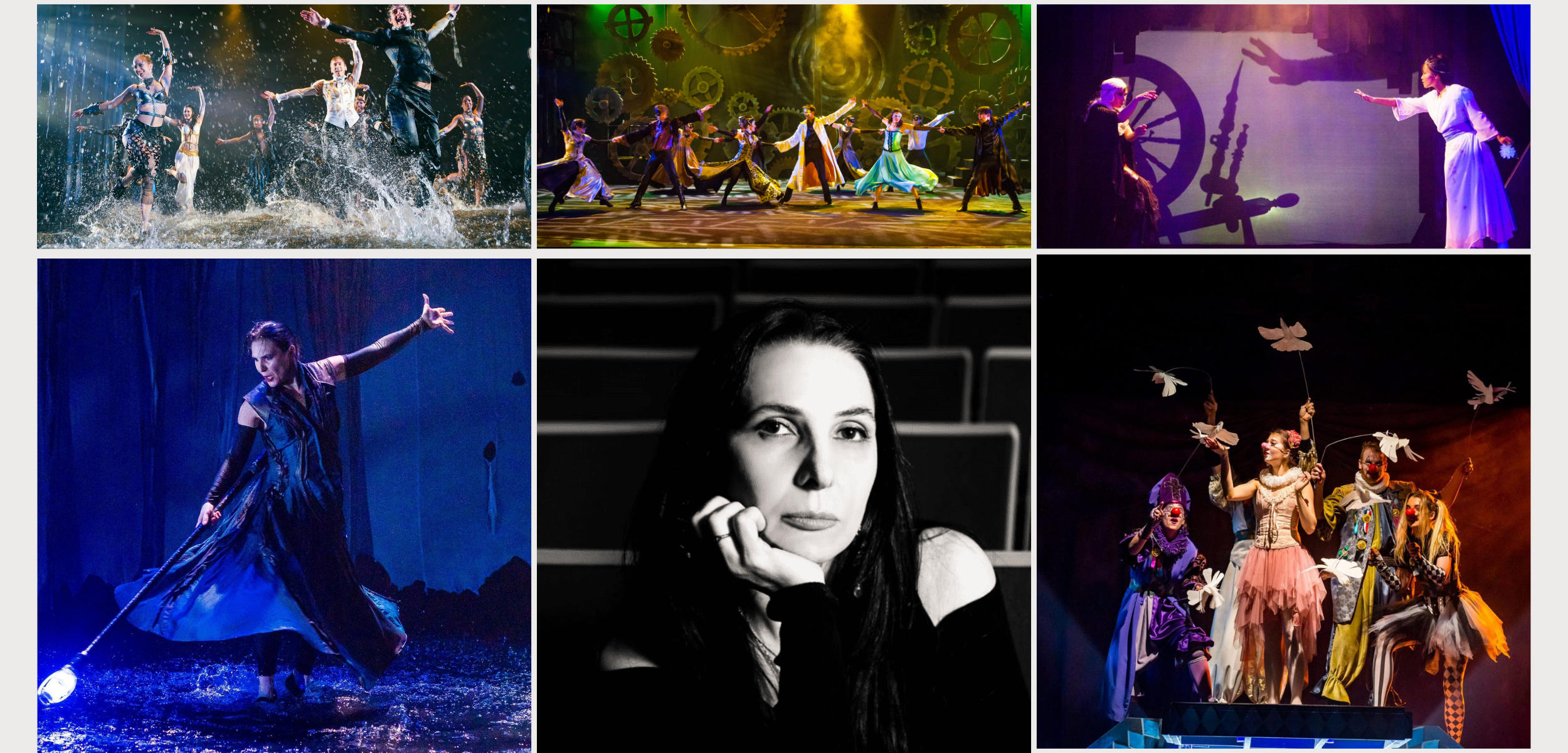
Long before she became the co-founder of Synetic Theater and a recipient of 14 Helen Hayes Awards, Irina lived through the collapse of a country. Trained as a classical ballerina at the Chabukiani National Ballet Academy in Tbilisi, she entered adulthood just as the Soviet Union disintegrated and Georgia plunged into civil war, poverty, and lawlessness. Electricity vanished, food disappeared, and violence became routine. Together with her husband, theater director Paata Tsikurishvili, she struggled to endure a reality where artists became farmers, nights were ruled by gunfire, and daily life demanded resilience.
Amid the uncertainty of their safety, the family made the decision to leave. In 1998, Irina, Paata, and their son, Vato, arrived in the United States with limited English and no clear plan. What followed was not an immediate success story. It was years of work without stability, performing wherever space was offered, building an artistic language from the ground up. Out of this persistence, Synetic Theater was born. Irina has since choreographed nearly 90 Synetic productions—from Dracula and Frankenstein to The Dybbuk and Carmen—developing a signature style that blends rigorous classical technique with emotionally driven, wordless storytelling.
Finding a Language
I was trained as a ballerina. My father, a well-known gymnastics coach in Georgia, first placed me in a gymnastics school, but when my body began to change, he decided ballet would be better for me. I had always loved ballet, though I never imagined I would practice it myself. For eight years, I studied under a tyrannical teacher whose relentless criticism slowly but surely destroyed my love for classical ballet. Our repertoire was extremely narrow—limited to the foundations of the classical canon—but the problem was not the performances themselves. The absence of soul lay in the daily work at the barre: endless, lifeless exercises devoid of imagination and inner purpose. We moved like mechanisms, like soldiers, repeating the same dull combinations over and over again. My only dream became simply to endure to the end and never return to the barre again. Even as ballet began to feel empty, my need for movement remained. I was searching, without fully realizing it, for a form of expression where movement meant something beyond technique, where it could speak with honesty.
My classmates once took me to a pantomime theater, and I saw a production that stayed with me for years. I remember the lead actor most vividly, his expressive eyes and crown of curly hair, and the strange intensity of the silence onstage. I did not yet have words for what I was seeing, but I felt that this theater spoke directly to something inside me. This was not the pantomime the world is used to - not white masks, not the tradition of Marcel Marceau. It was a philosophical, dramatic form of pantomime, where deeply emotional stories unfolded entirely without words.
One performance forever changed my understanding of movement. It was a pantomime about the life of the Georgian painter Pirosmani, a self-taught artist whose simple, poetic images captured the spirit of his country. The performance took place at the Shalikashvili Pantomime Theatre, where Amiran Shalikashvili himself portrayed Pirosmani. What struck me most was that, right before my eyes, he seemed to be painting - and the performers became his paints, his paintings, his emotions, his colors, his agony, and ultimately his death. The Georgian dance in his performance was entirely unique. He played it as an actor, dancing only with his hands and fingers. Before your eyes, his fingers transformed into the movements of feet - fast, precise, unmistakably Georgian. It was virtuoso.
After finishing school, I planned to apply to a theater institute, but my family’s move to Yugoslavia forced me to postpone those plans. My dad received a work offer there, and we were all set to move. I wanted to do something before we left and hoped to join the Georgian dance ensemble Gordy to travel and perform abroad. When I discovered that the auditions were already closed, I looked for another path and decided to audition for the same pantomime theater I had seen earlier.
I was accepted, and only after joining the company did I realize that one of my new colleagues was Paata—the very actor whose performance had once captivated me. As we rehearsed together, a deep connection formed. He became my creative partner, and eventually, my husband.
From Spotlight to Silence
From the moment I joined the pantomime theater, I was hailed as a star. The expectations, especially from the director, were immense. I began in the student troupe and was swiftly promoted to the main professional company. Recognizing my background, he soon asked me to lead choreography classes for the seasoned actors themselves.
But his mentorship came with two personal edicts, delivered with stern finality: “Don’t cut your long hair,” he insisted—he liked it long—and, more pointedly, “Don’t ever get married. You are married to the theater.” I fell in love with Paata. Four months later, we were married. And I hadn't just married - I had married his favorite actor. The consequence was immediate and absolute. He began to ignore me completely, as if I had ceased to exist. When I became pregnant, the atmosphere grew colder, more unwelcoming.
By then, the country had already been unraveling for two years. Political upheaval began in 1989, after the violent crackdown on pro-independence demonstrators in Tbilisi, and its consequences now shaped everyday life. Within a few months, Paata and the theater traveled to Germany on tour, while I remained in Georgia. Several actors decided it would be better to stay in Germany for work as the situation at home deteriorated. We decided that Paata should remain there, while I stayed in Georgia.
Darkness Over Tbilisi
When the Soviet Union began to collapse in Georgia in 1989, I was very young—eighteen—and lived entirely in dance and theater. Politics felt distant and unimportant. When April 9 happened, I didn’t immediately grasp its meaning—only the anxiety in people’s voices and the unanswered questions about what was unfolding.
The next morning, on the metro to school, panic erupted: people running, screaming, a fear that felt like war. At school, half the students never arrived, and those who did sat in silence and cried. Only later did I understand that on April 9, 1989, peaceful pro-independence demonstrators in Tbilisi had been violently attacked by Soviet troops, leaving 21 people dead and hundreds injured - a moment that became a turning point in Georgia’s fight for independence. As the Soviet Union collapsed soon after, Georgia descended into chaos: savings became worthless overnight, money turned into meaningless paper, and it felt as though the country had been thrown back into another century.
At first the electricity went out for a few hours, then for days, and eventually the entire city was left without power; we adapted to the darkness, then to the loss of water, gas, and to the sound of gunfire. Tbilisi sank into both literal and moral blackness—apartments reeked of dampness, people ran with buckets when water briefly appeared, and survival felt humiliating.
War broke out in Abkhazia, driven by outside interference and separatist interests, flooding Georgia with refugees and deepening the country’s collapse. Violence spread, stories of brutality circulated, and drugs—especially morphine—became widespread, even among children. Criminality turned into status: gangs divided the city, kidnappings became common, and being a criminal was suddenly considered “manly.” Gangs fought openly, and gunfire echoed at night, setting off car alarms. The police were no different from criminals—extorting money, stealing fuel, and working alongside gangs—so much so that survival meant constant fear, improvisation, and learning to live with violence as an ordinary part of daily life.
Before Paata left for Germany, our family received a large plot outside the city through President Zviad Gamsakhurdia’s land program, meant to help families survive by growing their own food. My husband began farming it, working late at night because the irrigation canal only opened then. We grew beans, corn, and greens and managed two full harvests, loading the car with sacks of produce as winter approached. But driving at night was dangerous—armed gangs often blocked the roads. Once, men with automatic weapons stopped us and demanded a ride; our car was too full, and when our son began crying loudly, they let us go. Another time, the road was blocked again, and as we sped away, they opened fire on the car, but we escaped. Death became routine—I attended memorial services twice a week, week after week.
Once, while trying to buy kefir for my six-month-old, I waited in line for several hours from early morning, only to hear that no food would arrive that day. A man in the queue collapsed and died because the ambulance refused to come—there was no fuel. I had to go to the market instead, where the crowd was twice as large. Moving slowly through the throng, I suddenly realized the line ahead of me had split in two, and a man lay on the ground—dead. I had no choice but to step over him. At that moment, I thought to myself, Irina, you just stepped over a dead body—and nothing moved inside you. Are you completely numb?
As there was no gas or electricity, people cooked over open fires outside their homes. I remember sitting there, trying to make a simple soup—potatoes, onions, carrots—for my son. He hated that soup, but I was proud I had managed to buy the ingredients. Then snow began to fall, slowly at first, and it put the fire out. I sat there and laughed. A neighbor passed by, stopped, and asked, “Irina, why are you smiling?” I didn’t know how to explain that laughter was the only way I could survive the madness around me. But in that moment, I also understood something clearly: I had to leave. I had to give us a chance at another life.
That decision set everything else in motion. Later, I received an American visa. At that time, my father was working in the United States as a gymnastics coach, and with his help I obtained a work visa as a choreographer. That is how Paata and I moved to the United States.
A New Stage
America had always lived in my imagination; from elementary school, after watching films, my friend and I dreamed of walking down Broadway and leaving the Soviet Union behind. Even at school I defended New York when teachers spoke dismissively about it, repeating what my father had told me—that it was an extraordinary city—and for me, America even had a smell: the watermelon gum he brought home.
Soon after our arrival, Paata and I created a small program for two performers and played anywhere we could—on the streets, at festivals, even in restaurants. Later, we were invited to join a Russian classical theater and worked closely with one of its founders Andrey. We later opened our own theater - Stanislavsky theater. Our first major production, Pushkin’s Little Tragedies, brought me a nomination for a choreography award, followed by The Idiot by Dostoevsky. Over time, we realized our artistic vision no longer aligned with the direction of the Stanislavsky Theater, so we left and founded our own company - Synetic Theater.
Early on, we were warned that a husband and wife should never work together onstage, but we proved that wrong. I may see a scene one way, Paata another, and we rehearse until one of us gives in; sometimes our son Vato, who now works with us, takes a side. It can get emotional, but it’s always about the work.
Since the opening in 2001 we have created nearly 90 productions. When I received my first Helen Hayes Award, I barely spoke English. I had been in the country for three years but my English was still very poor. I specifically didn’t prepare a speech as I wanted it to come from the heart. I said how grateful I was to this country—a country of possibilities—where my dreams came true in ways I never expected. I never imagined we would have a theater. We didn’t know where to start, but we began anyway!
On Georgian Fashion
People say Coco Chanel’s first model was Georgian, and during the Soviet years Georgians truly loved to dress well. I remember evenings in the mid-1980s when people walked up and down Rustaveli Avenue just to show their outfits. We stood and watched, absorbing it all. No matter how hard life was, no matter how hungry, but we were always well dressed. Years later, returning to Georgia after time away, I brought all my best clothes, convinced everyone would be looking at me—but instead I saw refugees from Ossetia: exhausted, starving, displaced. I felt ashamed, changed into jeans, and from then on dressed simply, even for events, in solidarity. My grandmother, who was Ukrainian and sewed for me, and my father, who traveled widely and brought me clothes from abroad, shaped my sense of style, though in America I’ve grown lazy and mostly live in jeans and T-shirts.